Available Now

Stop Buying
Confusion.

How to Evaluate, Negotiate, and Partner with IT Security Providers.
The tactical manual for the C-Suite to escape the "Fear, Uncertainty, and Doubt" sales cycle.
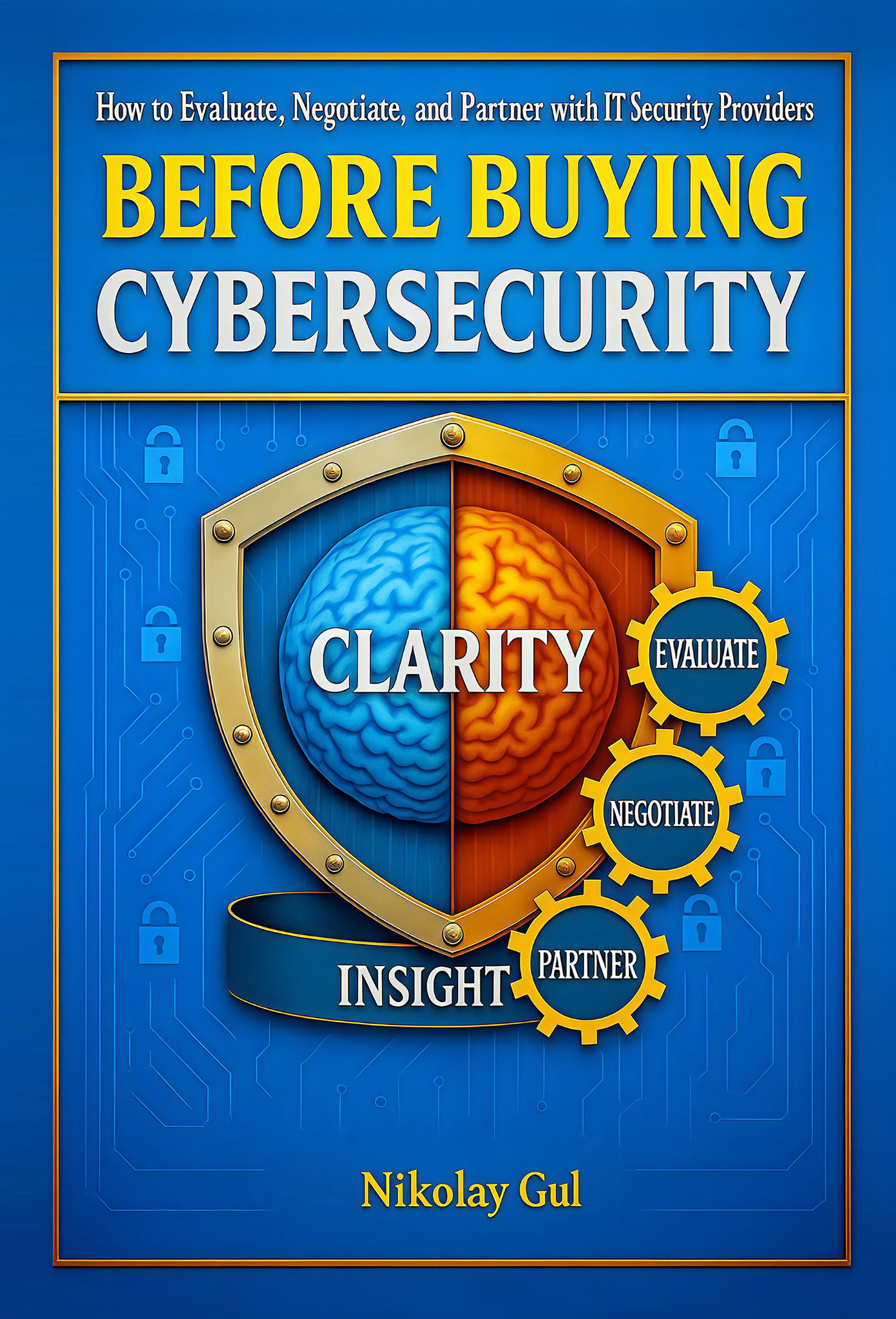
Book Cover: Before Buying Cybersecurity

Available Worldwide On

Evaluate Your Vendor

Use the book's Clarity Matrixβ„’ formula to score your current provider. Drag the sliders based on your experience.

Formula: (Transparency Γ— Competence Γ— Consistency) Γ· Ego Bias

Do they admit mistakes and share logs openly?

Measurable results vs. marketing buzzwords.

Predictable performance month over month.

Defensiveness, jargon, and blaming others.

Score

Core Frameworks in the Book

The manuscript provides structured models to help leaders stop buying confusion and start acquiring verifiable resilience.

πŸ’‘ Clarity Matrix

A trust-scoring logic expressing the idea that trustworthiness increases when transparency, competence, and consistency rise, and decreases when ego bias is present.

Formula: (Transparency Γ— Competence Γ— Consistency) Γ· Ego Bias

πŸ’‘ Cost of Confusion Formula

A method to quantify financial loss from unclear vendor language, vague proposals, hidden boundaries, and mismatched expectations.

πŸ’‘ Cognitive Firewall

A mental filtering system executives use to detect manipulation, ambiguity, or fear-based selling, especially in complex cybersecurity conversations.

πŸ’‘ Vendor Integrity Scorecard

A multidimensional evaluation tool assessing vendor behavior across transparency, accountability, evidence quality, escalation discipline, and outcome reporting.

Cyber Clarity GPT Agent

Meet Your New Negotiation Partner

I have trained a custom GPT Agent on the entire manuscript. It doesn't just summarize the bookβ€”it helps you apply it.

  • βœ“ Draft RFPs that filter out bad vendors instantly.
  • βœ“ Simulate high-pressure negotiations before the meeting.
  • βœ“ Audit your current contracts for "weasel words."

Inside the Manuscript

Introduces the idea that most cybersecurity failures start before an attack ever happens, when decision-makers trust without verification and sign contracts they don’t fully understand.

Explains how unclear language, fear-based selling, and fuzzy responsibilities quietly drain budgets and increase risk over time.

Shows how some vendors weaponize complexity and ego, and teaches readers how to mentally firewall themselves against manipulation.

Reframes risk from a purely technical concept into a business map of dependencies, data, people, and processes.

Contrasts reactive, panic-driven cybersecurity purchases with a structured approach based on clarity, verification, and measurable outcomes.

Introduces a focused question set that reveals how a vendor actually works, how they respond under pressure, and how they think about accountability.

Defines what counts as real evidence in cybersecurity and how to distinguish between cosmetic reporting and meaningful proof.

Clarifies which responsibilities belong to vendors, which belong to internal teams, and how to prevent gaps between them.

Explains why having backups is not the same as being able to restore, and why rehearsal matters more than technology labels.

Shows how to translate vendor tool lists into business outcomes, including uptime, resilience, and verifiable reduction of risk.

Describes how people, culture, incentives, and communication patterns can either support or quietly sabotage security efforts.

Introduces a mathematical and conceptual model for scoring vendors on transparency, competence, consistency, and ego.

Provides negotiation strategies focused on verification, measurable commitments, and aligning incentives instead of haggling over fear.

Explores AI-driven defense, autonomous actions, and the need for clear override and accountability rules.

Explains how unofficial tools and unapproved AI use can undermine even the best security program, and how to bring them into the light.

Shows how to turn painful incidents and near misses into structured learning and stronger contracts.

Provides a pragmatic view of long-term cryptographic risk, regulatory shifts, and the importance of future-proof decision-making.

Helps readers design a simple operating system for security decisions, reporting, and vendor management centered on clarity.

Pulls the frameworks together into practical action plans for boards, executives, IT leaders, and vendors.